

“AI will replace jobs” was the debate of 2025. After six months working at a frontier AI lab, I’m privileged to have a different take. (Six months doesn’t sound long, but in AI time it’s an eternity.)
Tl;dr: AI didn’t replace my job. It replaced the easy parts. And that made everything harder.
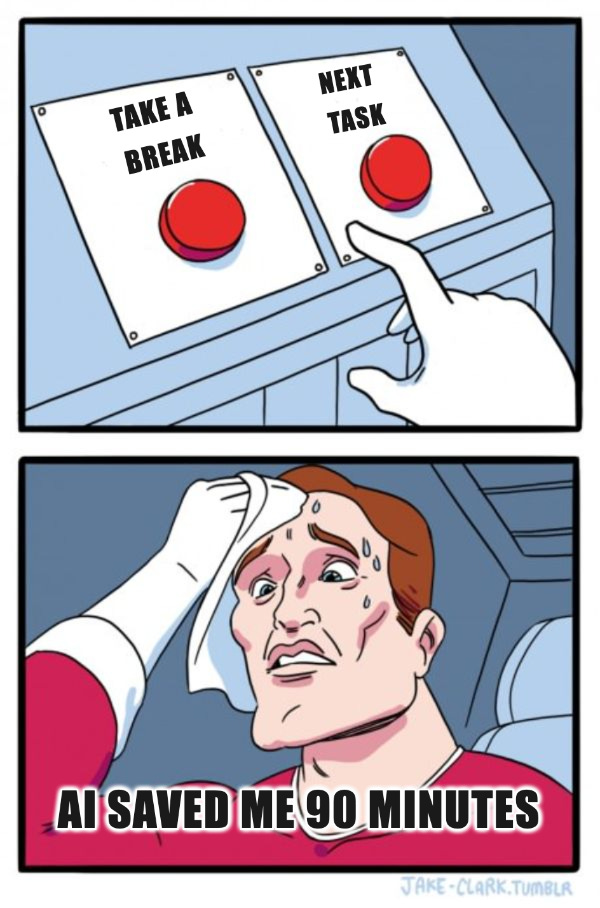
First, the time AI saves becomes time for more thinking.
If AI reduces a coding task from 2 hours to 30 minutes, you don’t get 90 minutes of rest. You get 90 minutes of the next problem, either delivering three similar tasks or deciding what to tackle next. The cognitive load doesn’t decrease. It concentrates.
Second, AI takes the fun parts of the job.
Writing code, for example, used to have rhythm. You’d get in “the zone”—a meditative state where your mind wanders productively and your fingers follow. It is work, but it is also rest. That’s why most software engineers love coding. When AI writes the code, that rhythm disappears.
Third, AI hallucinations mean constant verification.
In coding, it’s easy to test if AI got it right. Worst case, you verify it in production. (Please don’t do that.) In people management, as contrast, verification is more complicated. AI provides confident answers, but you can’t just trust them—not yet.
In sum: you’re accountable for the next cognitive heavy lift, AI took the enjoyable part, and you have to verify everything it produces. This is a recipe for burnout.
But here’s the thing: we’ve been here before.
Think about the shift from pencils to keyboards. Writing by hand was slow, but satisfying. Typing killed that ritual and opened up something better: faster editing, versioning, and document retrieval.
Or more dramatically, film to digital. Every shot mattered when you had 24 exposures. You waited days to see your photos. Digital destroyed that magic and created something entirely new: instant sharing, smart albums, and storytelling.
Each transition inevitably killed a ritual we didn’t know we loved, yet created possibilities we couldn’t have imagined.
I don’t know what the new rhythm looks like yet. But we should be excited (and maybe a little scared) about the adventure ahead.
Happy 2026.
The sharing keeps me think. The next generatiom could be the Agentic Engineering era IMHO.